车震
布局四季化产品 国内羽绒产业主动谋变_我的网站

一 | 据世界气象组织与我国气象部门研判,当前持续发展的厄尔尼诺事件强度持续走高,2027年有可能刷新全球最暖年份纪录。极端气候放大效应之下,羽绒行业正遭遇上游原料供给收缩、下游消费需求不确定性加大的双重挑战,倒逼产业加速产品创新与供应链数字化转型。
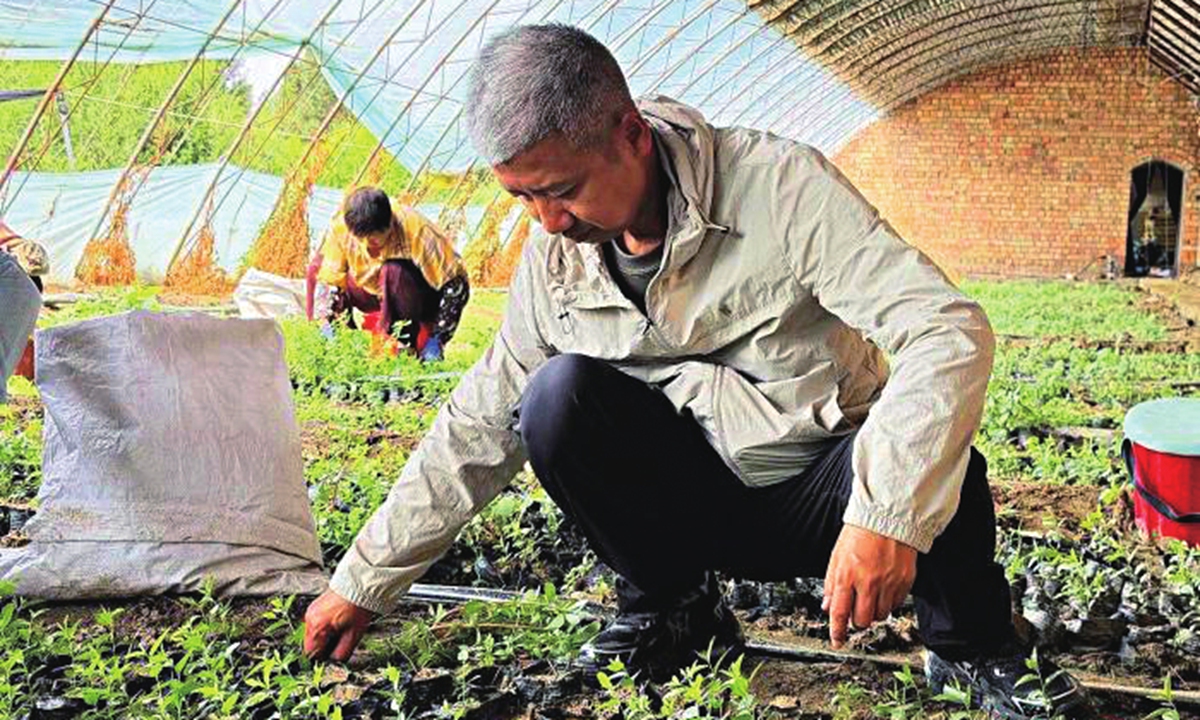
Wensuyalatu checks the growth of sour jujube seedlings. Photos: Chinanews.comAcross the vast desert landscape of the Urad Rear Banner in North China's Inner Mongolia Autonomous Region, one grassroots official has spent more than three decades turning barren sands into patches of green.
Ecological restorationFor over 30 years, Wensuyalatu, a member of the leadership group of the Urad Rear Banner forestry and grassland bureau, has made the Gobi Desert his workplace, dedicating his life to combating desertification, advancing ecological restoration through technological innovation, and helping local herders increase their incomes, according to the local bureau's official WeChat account.
Located on the edge of the desert in Bayannur's Urad Rear Banner, it is a key area in China's Three-North Shelterbelt Forest Program, a major ecological project aimed at strengthening the country's northern ecological security barrier.
However, early afforestation efforts in the desert were far from easy at the start.
The project covers 103,800
mu (about 6,920 hectares), including comprehensive treatment of 24,500
mu of desertified land, ecological restoration of 4,100
mu of non-desertified land, and 75,200
mu of enclosed grassland restoration. The project also includes the construction of 11 small-scale water conservation facilities, all of which required strict standards and extensive coordination.
The project also includes the construction of 11 small-scale water conservation facilities, all of which required strict standards and extensive coordination.
In 1991, Wensuyalatu, then in his early 20s, chose to devote himself to forestry and grassland conservation in the Urad Rear Banner. Since then, he has remained on the front lines of desertification control, witnessing the region's harshest environmental challenges and working to find solutions adapted to the fragile desert ecosystem.
In the early years, afforestation in the Gobi Desert was an extremely difficult task. The most critical planting season in spring often coincided with the strongest sandstorms of the year. Every year during the key afforestation period, Wensuyalatu would stay deep in the desert, guiding workers on planting techniques and management practices, while carefully overseeing every detail of the ecological restoration projects.
"Every spring, the wind and blown sand were so strong that it was hard to keep your eyes open. The sand hit your face like needles. During the day, we followed workers to dig holes and plant trees, and at night we stayed in temporary shelters to organize data and review the day's work. That was the normal routine for desertification fighters," Wensuyalatu recalled.
The road to restoring the desert was far from easy. Years of drought, low survival rates of seedlings, and skepticism from some local residents created major obstacles.
"At the beginning, it was really difficult. The climate was extremely dry, and many seedlings died after being planted. Some herders did not understand or support the work. They believed deserts were naturally barren and that no amount of effort could make trees grow there," Wensuyalatu said.
To change these perceptions, Wensuyalatu brought local residents to see firsthand the damage caused by desert expansion. Through visible results and long-term communication, he gradually won the understanding and support of the community.
Facing the ecological challenges of the Urad Rear Banner, Wensuyalatu began exploring new approaches beyond traditional restoration methods.
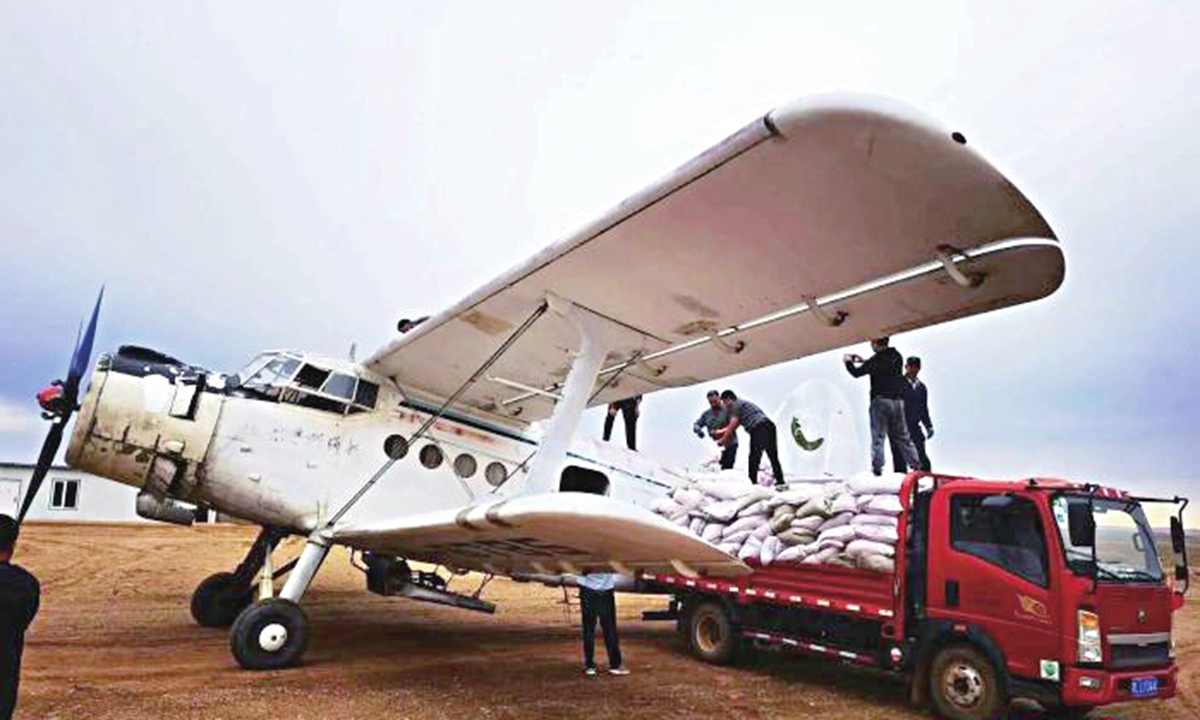
Staff members get ready to carry out aerial seeding operations.
Aerial seedingSince 2004, he has led efforts to tackle desert restoration challenges by introducing large-scale aerial seeding projects, creating a breakthrough approach for restoring degraded desert ecosystems in the region.
"Compared with traditional methods, aerial seeding is more efficient and can cover wider areas. Based on local climate and soil conditions, we select suitable desert plant seeds and precisely control the seeding height, density and timing to improve survival rates as much as possible and accelerate desert recovery," Wensuyalatu explained.
After years of effort, the aerial seeding projects under Wensuyalatu's leadership have restored more than 800,000
mu of desert land, with an effective restoration rate of 62.2 percent.
He also developed an integrated management approach combining "protection, management, retreat, restoration and publicity," establishing a mixed vegetation system of trees, shrubs and grass to curb desert expansion and reduce sandstorms at their source.
Beyond restoring greenery, Wensuyalatu has also focused on strengthening scientific research and protecting native desert species.
Starting in 2010, he devoted himself to the artificial cultivation of endangered native desert plants. After more than a decade of repeated experiments, he successfully developed cultivation techniques for rare species such as the endangered evergreen broadleaf shrub
Ammopiptanthus mongolicus, Mongolian almond and drought-resistant elm.
Under his leadership, his team cultivated 6.5 million seedlings and completed more than 4,000
mu of high-quality afforestation projects, with seedling survival rates consistently exceeding 80 percent.
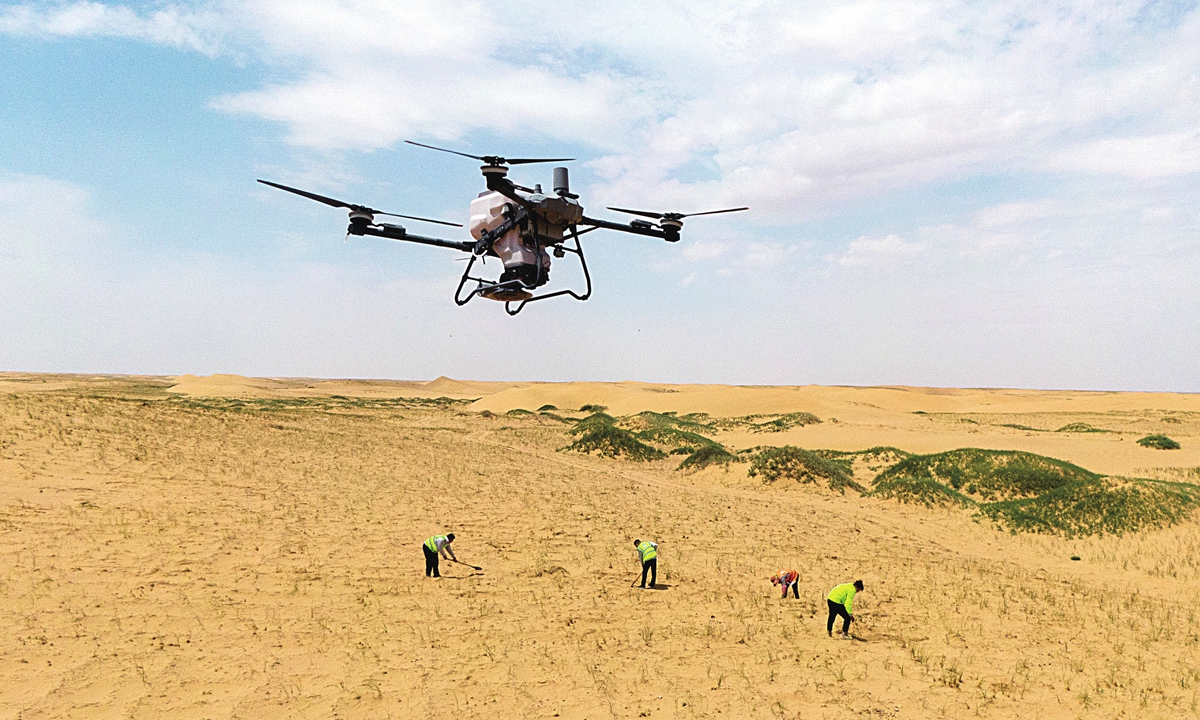
Engineering personnel operate drones to conduct aerial seeding as part of afforestation efforts in the Badain Jaran Desert in North China on June 17, 2025. Photo: VCGHis achievements filled a technological gap in large-scale cultivation of native desert plants and earned him second prize in the 2017 Inner Mongolia Autonomous Region Harvest Award.
For Wensuyalatu, desert restoration is not only about creating ecological benefits, but also about improving people's livelihoods.
He has long promoted the idea that "trees should bring both ecological value and economic value." By leveraging local desert resources, he helped establish a 10,000-
mu industrial base for desert plants and cistanche - a medicinal plant often grown in desert environments - across four key local villages, integrating ecological restoration with specialty desert industries.
"In the past, people thought desertification control was simply about planting trees - it took a lot of efforts but brought little income. Now things are different. By planting trees and developing industries such as cistanche cultivation, desert land can generate real wealth," a local herder said.
To ensure that local communities benefit from ecological development, Wensuyalatu introduced enterprises, supported family forest farms and professional cooperatives, and promoted large-scale, market-oriented operations.
The once barren desert has gradually become a "green treasure chest" for local herders, achieving a win-win outcome: greener landscapes, improved ecosystems, stronger businesses and higher incomes.
"Desertification control is not just an ecological project, but also a project that benefits people," Wensuyalatu said.
"Only when communities gain real benefits from protecting nature will they actively participate in ecological conservation. That is the key to making restoration efforts sustainable and achieving the vision that lucid waters and lush mountains are invaluable assets," Wensuyalatu said.
Global Times
。据监测,赤道中东太平洋已于今年5月进入厄尔尼诺状态,7月迈入强厄尔尼诺事件监测序列,发展为超强厄尔尼诺的概率持续上升,该天气事件预计至少延续至2027年春季,整体时长约10至11个月。海洋对大气存在滞后影响,强厄尔尼诺次年往往是气候影响的峰值阶段,因此2027年全球平均气温或将创下历史新高。强厄尔尼诺如同全球气候“放大器”,高温、干旱、暴雨洪涝、强台风等极端天气发生概率显著提升。秋冬季我国南方降水增多,来年春夏长江及江南区域洪涝风险加大。极端天气传导至产业链上游,直接冲击羽绒原料供给。中国羽绒工业协会官网刊发的文章指出,羽绒原料主要来源于肉鸭、肉鹅屠宰加工副产品,持续高温会带来畜禽热应激反应,鸭鹅采食量降低,生长周期拉长,死淘率上升,羽毛的产量与品质同步下降。与此同时,暴雨洪涝容易诱发养殖疫病,叠加降温、防疫带来的成本抬升,养殖户补栏意愿下降,行业远期产能走弱,羽绒原料或将迎来持续收紧的压力。在消费端,厄尔尼诺背景下我国冬季出现暖冬的概率增加,一定程度会压制传统厚款羽绒制品的季节性需求。但暖冬不等于无寒冬,全球变暖背景下冷暖空气交汇更为剧烈,阶段性寒潮依旧时有发生,会带来保暖消费品的突发性、短期爆发式消费,让市场需求呈现更强的波动性。

二 | “气候不确定性正在重塑羽绒行业的发展逻辑,行业不能再单纯依靠寒冬拉动销售。”业内人士表示,面对天气变量带来的供需波动,国内羽绒产业正在主动谋变。产品端,企业跳出厚重冬季御寒单品思维,大力布局轻量化、四季化、多场景羽绒产品,拓展羽绒寝具、户外轻量羽绒等品类,降低对冬季低温的单一依赖。供应链层面,行业加快资源整合,通过抱团协作对冲原料波动风险。

三 | 同时,数字化、智能化生产体系建设提速,通过市场数据感知消费变化,实现柔性生产、敏捷调配物流,推动供给端精准匹配多变的市场需求。业内专家提醒,气象预测为产业提供重要参考,企业应当建立气候风险预警意识,结合气象研判优化库存规划与订单节奏,提升产业抵御极端气候冲击的韧性。 。
Current article:http://druppbf.zhouangnaoguangsundianzhenmou.cfd/news/20260826_7523474.html
Published on:18:26:18