126
US, Qatar agree to prevent Iran from tapping previously frozen $6 billion fund_我的网站

A |
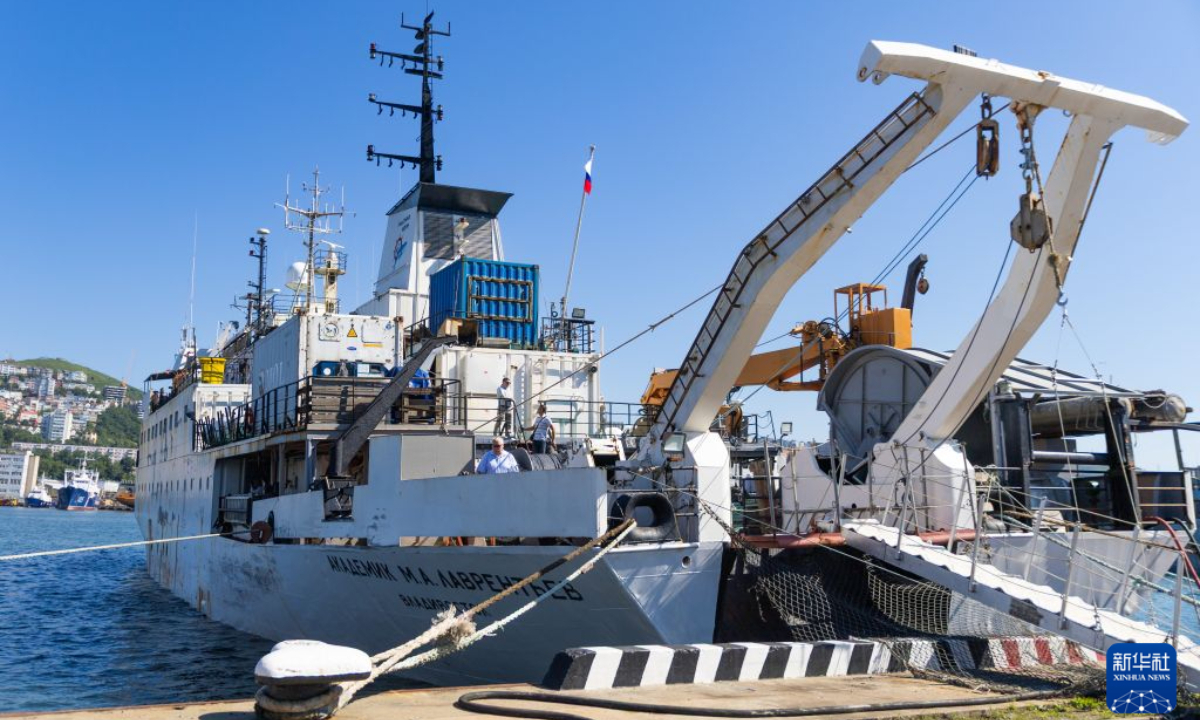
The fourth China-Russia joint Arctic expedition was launched on Thursday in Russia’s Far Eastern city of Vladivostok. Scientists from both countries will conduct major frontier basic research on the rapid climate changes in the Arctic region, focusing on the area from the Northwest Pacific to the Arctic Ocean, Xinhua News Agency reported on Thursday. Nine people from China will participate in the voyage.
At the launch ceremony, Wei Zexun, director of the First Institute of Oceanography, Ministry of Natural Resources (MNR), said the joint expedition will focus on the waters of the Northwest Pacific and the Arctic Ocean, further deepening scientific understanding of ocean dynamic processes, climate change patterns, and marine ecosystems in the study areas. It is not only a concrete measure to implement the cooperation consensus between China and Russia in the marine field, but also a vivid example of the two countries’ comprehensive strategic partnership of coordination in marine science and technology in the new era.
According to Du Libin, executive dean of the College of Ocean Science and Engineering, Shandong University of Science and Technology, the Arctic is highly sensitive to global climate change, and a frontier for ocean science, playing a key role in the “Polar Silk Road” initiative and China-Russia polar marine cooperation.
The joint expedition will highlight deeper marine research cooperation and innovation, while advancing polar scientific exploration and practical collaboration between the two countries, Du said.
According to Zou Jianjun, chief Chinese scientist of the scientific expedition team and a researcher at the First Institute of Oceanography, MNR, the expedition will last about 62 days. The scientists will conduct multidisciplinary surveys in the Chukchi Sea, East Siberian Sea, Lomonosov Ridge, Makarov Basin, and Amundsen Basin to study changes in the marine environment of these regions amid rapid climate change and reveal their response processes and feedback mechanisms in relation to global climate change.
A representative from the Pacific Oceanological Institute (POI), Far Eastern Branch of the Russian Academy of Sciences, said during the ceremony that the joint expedition is expected to strengthen Russia-China ties and expand cooperation in the Arctic and Pacific regions.
As freight volumes along the Arctic shipping route are steadily increasing, and the role of Arctic shipping route in the global economy is becoming increasingly important, comprehensive scientific research of the region has become necessary.
Global Times
。 The U.S. and Qatar have reached an agreement to prevent Iran from accessing $6 billion recently unfrozen as part of a prisoner swap, the deputy treasury secretary told lawmakers on Thursday, sources confirmed to ABC News.Deputy Secretary Wally Adeyemo told House Democrats in a closed-door briefing that the money "isn't going anywhere anytime soon," sources said.The agreement comes as the U.S. is scrutinizing Iran's role in backing Hamas, the terrorist group behind the unprecedented attacks on Israel over the weekend. Though the Biden administration said there's been no evidence that Iran played a direct role in the assault, the White House has said Iran is complicit given its decades of support for Hamas.The administration has faced calls from lawmakers on both sides of the aisle to re-freeze the funds in the wake of the violent conflict.The $6 billion in Iranian oil revenue was freed up last month as part of the U.S.-Iranian prisoner swap in which five American citizens were freed. It was made available solely for humanitarian purposes and is under strict U.S. oversight.The White House on Thursday repeatedly stressed that Iran has not yet tapped this humanitarian fund."Every single dime of that money is still sitting in the Qatari bank. ... Not one dime of it has been spent," National Security Council spokesman John Kirby told reporters.But Kirby went to great lengths not to comment publicly on this new understanding to prevent Iran from tapping these funds.ABC News Chief White House Correspondent Mary Bruce pressed Kirby about whether Iran could access the money if it wanted to."What I can tell you is none of it has been accessed and we are watching every dime as you would expect we would," he responded. "We're watching it very, very closely. ... We have oversight over -- over what can be assessed and for what purposes."Asked whether he didn't want to discuss the matter because of concerns that it would imply Iran's culpability, Kirby again stressed, "All I can tell you is we haven't seen any specific evidence that Iran was involved specifically with these attacks, but as we've said, broadly, yes, they're certainly complicit."Peppered with questions on the funds repeatedly during the press briefing, one reporter finally asked: "On the $6 billion, I'm trying to figure out if you' re saying that policy hasn't actually changed in any way or just that you aren't willing to talk about changes that may have happened in the last 24 hours?""Bingo! It's the last one," Kirby exclaimed.Secretary of State Antony Blinken, who visited Israel on Thursday in a show of support, also stressed the $6 billion fun could only be dispensed for humanitarian goods, medicine, medical equipment, and has "never touched Iranian hands.""We have strict oversight of the funds and we retain the right to freeze them," Blinken said.。

B |
Current article:http://druppbf.zhouangnaoguangsundianzhenmou.cfd/news/20260826_23835.html
Published on:12:46:14
 布达佩斯
布达佩斯 意外
意外 打架成本警示牌
 拜托小姐
拜托小姐 白夜追凶
白夜追凶 百里挑一
百里挑一 桃花期
桃花期 头脑风暴
头脑风暴


